
SHAPE Explained
The five conditions that make culture work
Meredith Wilson
SHAPE names the five conditions that define the culture workplaces need for the now and next of work: Safety, Hope, Autonomy, Purpose and Exploration. Leaders who understand what people need from culture at this level build it deliberately.
What people actually need from culture
Leaders spend billions every year trying to shift culture. They run engagement surveys, launch values campaigns, bring in consultants, redesign offices, reshape pay systems. The question worth asking precisely: what do people actually need from their workplace culture to do their best work?
Common answers point to real things. People want to feel valued, to have agency, to make an impact. These are the outcomes. A leader architects the conditions that create them.
SHAPE identifies those conditions. It draws on decades of research in psychological safety, self-determination theory and growth mindset, translated into language leaders can understand and work with: Safety, Hope, Autonomy, Purpose and Exploration.
The outcome, when all five conditions are in place, is described in Culture Creates Capacity. The cumulative effect of sustaining those conditions over time is explored in Capacity is Cumulative.
The five conditions
Safety is the foundation. People do their best thinking when they feel safe from embarrassment, retaliation or exclusion. Safety means they can speak up without calibrating risk. They can fail without it becoming a story about their competence. They can ask for help or admit they do not know something without social cost. Organisational cultures without safety run slower because people spend energy managing perception instead of generating ideas.
Hope is the counterbalance to safety. It is the belief that things can get better, that effort matters, that there is a path forward even when the present is difficult. It is the conviction that change is possible and that their contribution shapes that change. When hope is absent, people execute what they are told. When hope is present, they choose to contribute.
Autonomy is the freedom to make decisions that matter, to exercise judgment about how the work gets done. It is clarity about what is yours to decide and the trust to decide it. Organisations that remove autonomy require approval for every small decision and slow themselves down. They also signal that their people cannot be trusted with judgment.
Purpose connects the day-to-day work to something larger. Why does this work matter? How does it connect to the organisation's mission or its customers or the problem it is trying to solve? Purpose answers the question: Am I doing work that matters, or am I moving tasks? When people understand purpose, they make better trade-offs and decisions without needing approval. They also show up differently, even for difficult work.
Exploration is permission to learn and experiment. It is space to ask “what if” without catastrophic consequence. It makes learning part of the culture, built in by design. Some experiments will fail. That is the point. Organisations without exploration cultures plateau. They optimise what they know. They do not discover what they do not yet know.
The everyday consistency of these conditions is what makes the difference between conditions that last and conditions that drift. Boring is Better describes the practice.
Why SHAPE matters to leaders
SHAPE is diagnostic. When a team is underperforming, the instinct is to look for skills gaps or effort problems. Often the gap is something different. People have the skills and the will, but one of the five conditions is missing. A team might have high safety and purpose but no autonomy: they are waiting for permission to act. Another might have autonomy and purpose but no safety: people are protecting themselves instead of collaborating. SHAPE helps leaders see which condition is missing and where to focus.
The framework also interrupts a dangerous pattern. Leaders often try to shift culture by adding: add a new value, add a program, add a metric. SHAPE flips that. Sometimes culture works better when you stop doing something. Approval requirements shrink. Failure stops being punished. Purpose becomes visible. The conditions are often already there, and the work is removing the obstacles.
Where SHAPE connects
SHAPE describes what people need from culture. GRASS makes culture visible in the everyday moments where those conditions are either created or undermined: the meetings people attend, the rituals they follow, the stories told about what happened, the symbols that signal what matters. The Culture Stack helps leaders see why these conditions may not last: what historical layers are working against them.
SHAPE appears in Shift (2023) and is foundational to Meredith Wilson's culture diagnostic and transformation work with organisations. The gap between the culture leaders think they have and the culture people actually experience is explored in The Culture Leaders See, and the Culture Teams Experience.
SHAPE at a glance
| Condition | What to observe | What it reveals |
|---|---|---|
| Safety | Whether people speak up, raise concerns and acknowledge mistakes | How psychologically safe the environment is, and whether problems surface before they become crises |
| Hope | Whether people invest discretionary effort or do enough to get by | Whether people believe the future is worth working towards |
| Autonomy | How decisions are made and how fast the organisation moves | Whether people have enough agency to lead effectively within their role |
| Purpose | Whether people can connect their daily work to something larger | Whether the organisation can align without constant instruction |
| Exploration | Whether people ask questions, test ideas and admit uncertainty | Whether the organisation can adapt or can only execute what it already knows |
Your SHAPE Profile
Every team reflects a SHAPE pattern. The question is whether leaders can see it clearly enough to act.
— Which of the five conditions is strongest in your team right now?
— Which is weakest, and what does its absence cost?
— If you invested in the weakest condition first, what would change?
The answers tell you where to start, and what to work with.
Every leader creates a SHAPE.
You have read the five conditions. The next question is which of them your leadership creates. Safety, Hope, Autonomy, Purpose and Exploration show up in a pattern particular to you, with a strength your team feels and a cost it pays. Find out where yours stand, and the shift they point to.
About Meredith Wilson
Meredith Wilson makes culture simple and actionable. With over 15 years at the Executive and Board level in ASX10 and global teams, she has led culture through rapid growth, acquisitions, downturns and transformations. Now, as a speaker, author and mentor, Meredith works with senior leaders to shape, shift and lead culture, building the capacity needed for what's next.
Meredith delivers one-on-one mentoring, interactive masterclasses on culture and leadership and curated executive programs and experiences designed for senior leaders.
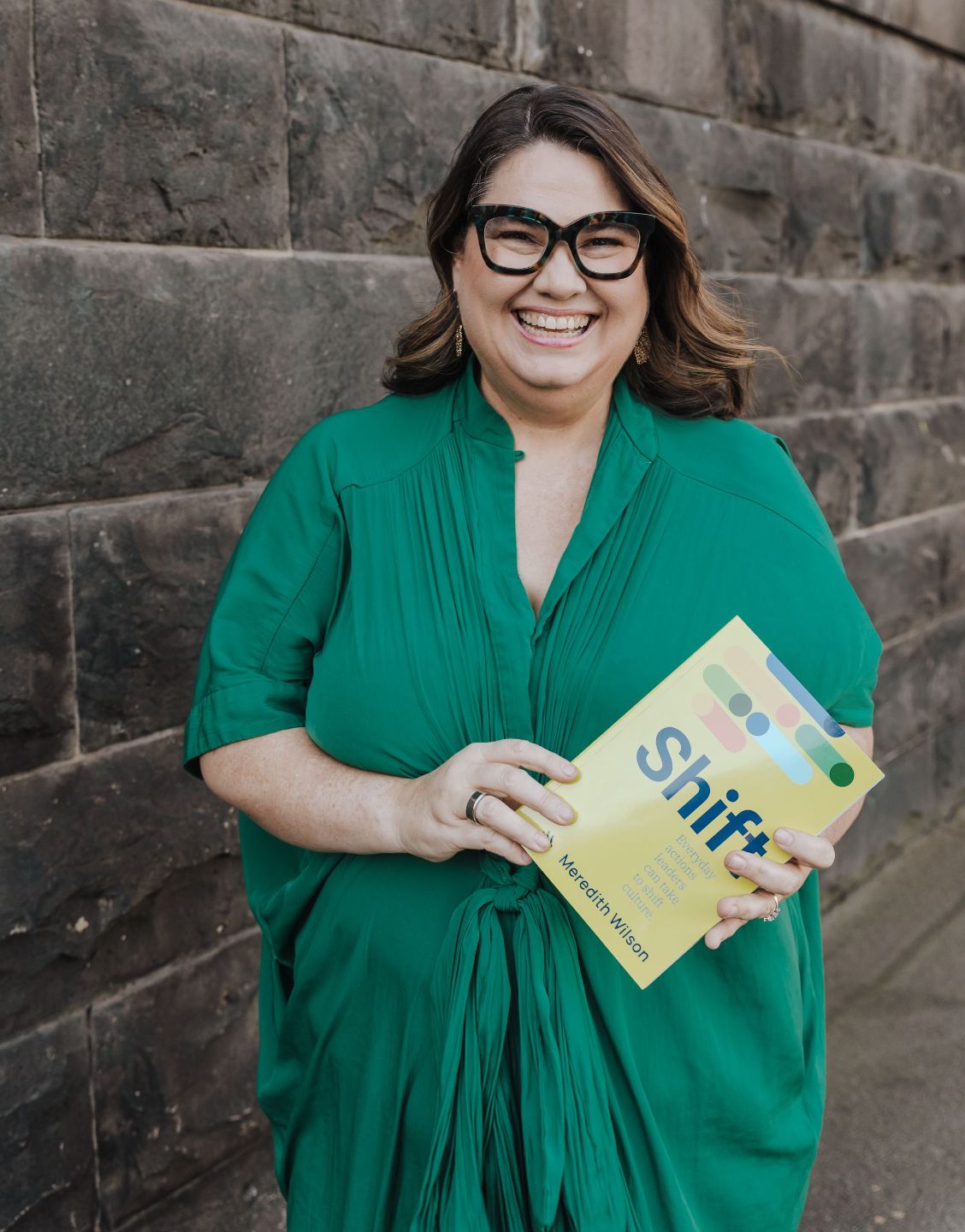
Meredith is the author of Shift: Everyday Actions Leaders Can Take to Shift Culture, a practical guide to making culture simple, tangible and actionable for leaders at every level.
Her depth of experience across people, culture and commercial leadership gives her a distinctive perspective. Grounded in operational reality, sharpened by three decades of practice.
Frequently Asked Questions
Can an organisation have high SHAPE scores and still have a poor culture?
SHAPE describes the conditions people need to do their best work. All five conditions matter, and they matter differently in different contexts. A research lab might lean hard on exploration. A manufacturing operation might lean on consistency. What matters is whether your conditions match your work. A high score in the abstract means little when the fit is wrong, and that gap is where problems start.
Is SHAPE the same as employee engagement?
Engagement measures how connected or motivated people feel. SHAPE describes the underlying conditions that create genuine engagement. People can feel engaged while doing work that pulls against strategy. People can feel less engaged and still perform well, because the conditions are there to support them. SHAPE is the foundation beneath engagement.
How do I know if my team has safety?
Look at what people do when they make a mistake. Do they hide it or report it? Do they stay quiet in meetings because it is safer, or do they contribute? Do they ask for help, or do they struggle alone? Safety shows up in the patterns of who speaks and who stays silent, who collaborates and who protects themselves.
If I improve autonomy, won't people make bad decisions?
Sometimes they will, until they develop judgment. The more common problem runs the other way: organisations constrain autonomy so tightly that people never develop the judgment to handle it. Autonomy paired with clarity about what is yours to decide is how people grow, and it slows the organisation far less than approval for every decision.
What's your next step?
Cultureshift™ Masterclass
How leaders multiply culture. 90 minutes online or two hours in person. A practical experience in reading, shifting and leading culture.
Leading Culture
Shape, shift and scale culture. A 12-month program for leaders responsible for making culture work at scale.
Get the book: Shift
Everyday actions leaders can take to shift culture. Practical, grounded and written for leaders who want to act.
Explore More
Related Explainers
The Five SHAPE Levers Explained — What leaders do to build the five conditions, one lever between each shift
How Workplace Culture Is Built in Layers — Why new values don't stick and what to do about it
Where Culture Shows Up in Everyday Organisational Life — Five tangible practices that make culture visible
What Makes Culture Stick — The small moments that shape how people experience culture
Also Published
Culture Creates Capacity — What SHAPE conditions produce when all five are present and sustained
Stay connected with Meredith
Subscribe to Culture creates Capacity, Meredith’s fortnightly reflections on leadership, culture and what’s next. Get insights, practical actions and early access to upcoming events and experiences.
We acknowledge First Nations people both here in Australia and around the world. We have the great privilege of working on lands that have had countless millennia of storytelling, learning, leadership and culture. We pay our deepest respects to the wisdom of Indigenous people and custom past, present and emerging.