
Leadershift Explained
The shift from managing people to leading culture
Leadershift is the shift in orientation that leading culture requires. It moves leadership from control to conditions: shaping the environment, creating safety and leading through complexity. Most leaders were trained for stable, predictable environments. Leadershift is the leadership a faster, more ambiguous context asks for.
What is Leadershift?
Leadershift is the recognition that leading today requires a different kind of leadership from the one most leaders were trained in. It is a shift in orientation. The leaders who shape culture well tend to lead through conditions and context rather than through control alone.
Most leadership development focuses on what leaders should do: set direction, make decisions, manage performance, deliver results. Leadershift asks a different question. What kind of leader does culture need you to be?
Why Leadershift matters now
The demands on leaders have shifted. The operating environment is more complex, more ambiguous and faster-moving than the models most leaders were trained in. The playbook built for stable, predictable environments strains when the context changes faster than the strategy cycle.
Leadershift names this gap. The technical expertise, the decisiveness, the command of detail that earned the promotion can become the very things that limit a leader when the job demands curiosity, comfort with ambiguity and the ability to create conditions for others to lead.
Culture work requires leaders who can sit with complexity without resolving it prematurely. Who can create safety while maintaining accountability. Who can be consistent without being rigid. These are shifts in posture. They sit deeper than a competency framework reaches.
The provocation
Leadershift challenges a long-held assumption: that stronger leadership means more control. In culture work, the leaders who shape the strongest cultures are the ones who create the conditions for others to lead within them. They cultivate. They create environments where better answers emerge. They create the space instead of filling it.
At a glance
| The shift | What most leaders were trained to do | What Leadershift requires |
|---|---|---|
| Orientation to authority | Lead through positional power and expertise | Lead by creating the conditions for others to lead |
| Response to ambiguity | Resolve uncertainty quickly to demonstrate control | Sit with complexity without resolving it prematurely |
| Definition of strength | More direction, more certainty, more control | Creating space so better answers can emerge |
Your Leadershift
The shift Leadershift names is already underway in most leaders. The question is whether it is happening by design or by default.
— Where in your current leadership are you defaulting to control when the situation is asking for something different?
— Which shift requires most attention right now: from authority to conditions, from resolving ambiguity to sitting with it, from direction to creating space?
— What would making that shift look like in a single interaction this week?
The answers locate where you are. They also locate where to start.
The practices Leadershift runs on
Leadershift describes the orientation. The Five SHAPE Levers describe what it looks like in practice. Consistency, Calibration, Choice, Clarity and Curiosity are the small, repeatable moves through which orientation becomes visible to the people a leader works with.
Consistency builds the predictability people read as safety. Calibration is the read of context, the same leader adjusting to what the moment asks. Choice directs attention, and what a leader attends to is what the culture learns to value. Clarity removes the tax of uncertainty. Curiosity keeps a culture adaptive as the ground shifts. These are the daily expression of the shift Leadershift names.
Where Leadershift sits
Leadershift is the leadership orientation at the centre of a wider body of work. SHAPE describes what people need to bring their best selves to work. GRASS describes where culture shows up in organisational life. The Five SHAPE Levers describe what a leader does to shape it, and each one sits between two of the five SHAPE shifts. Leadershift is the posture a leader brings to all of them. Leadership is the mechanism. Culture is the outcome.
The shape of your own leadership across all five is what the SHAPE Profile reads.
About Meredith Wilson
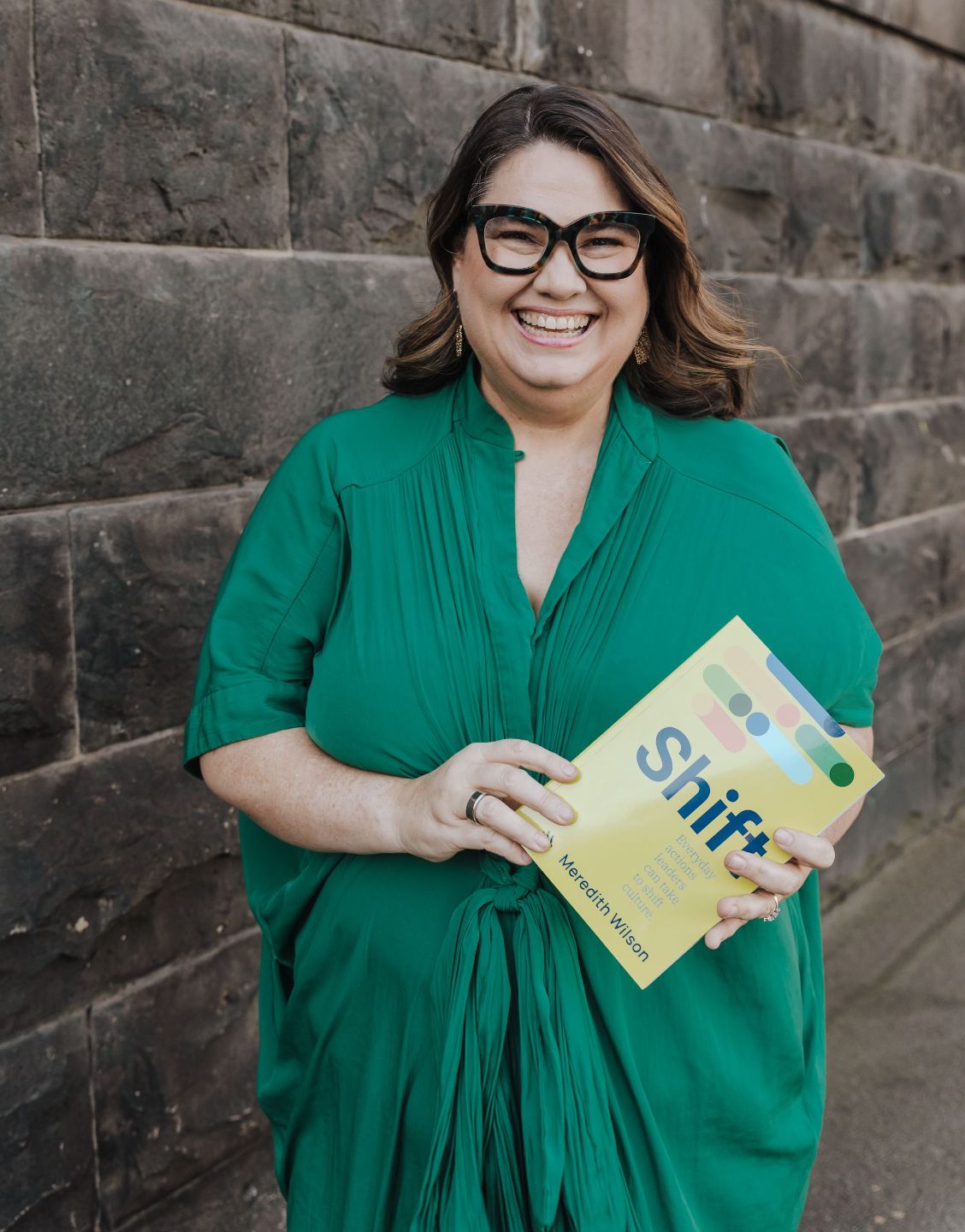
Meredith Wilson makes culture simple and actionable. With over 15 years at the Executive and Board level in ASX10 and global teams, she has led culture through rapid growth, acquisitions, downturns and transformations. Now, as a speaker, author and mentor, Meredith works with senior leaders to shape, shift and lead culture, building the capacity needed for what's next.
Meredith delivers one-on-one mentoring, interactive masterclasses on culture and leadership and curated executive programs and experiences designed for senior leaders.
Meredith is the author of Shift: Everyday Actions Leaders Can Take to Shift Culture, a practical guide to making culture simple, tangible and actionable for leaders at every level. She is now writing her next book, which develops the ideas behind Leadershift.
Her depth of experience across people, culture and commercial leadership gives her a distinctive perspective. Grounded in operational reality, sharpened by three decades of practice.
Frequently Asked Questions
What is Leadershift?
Leadershift names the shift in orientation that leading culture requires. Most leaders were trained in a model built for stable, predictable environments, where technical expertise, decisive authority and clear direction were the primary tools. Leadershift asks whether those same tools are the right ones when the job is to shape conditions, create safety and lead through complexity. It is a different kind of leadership, built for a different kind of work.
Why do experienced leaders find Leadershift challenging?
Leadershift is challenging precisely because it asks leaders to do less of what earned them the role. The decisive action, the command of detail, the quick resolution of uncertainty are the behaviours that get leaders promoted. Leadershift keeps those capabilities and adds discernment to them. The practice is to notice when they have become the default, and to read whether the moment calls for something else: creating space, staying curious, working through others.
How is Leadershift different from standard leadership development?
Most leadership development focuses on skills: what leaders should know and do. Leadershift focuses on orientation: what kind of leader does the work require you to be? Skills can be taught on a course. Orientation shifts through reflection, experience and honest assessment of what the work is actually asking. Leadershift works at the level of the model itself. It invites a leader to ask whether the way they lead needs to shift.
What does Leadershift look like in practice?
Leadershift is most visible in moments of ambiguity, when the instinct is to resolve and the situation asks for something else. A leader practising Leadershift resists the pull to fill silence, decide prematurely or direct when the team can find the answer themselves. It is a deliberate kind of presence. The shift is felt most clearly in how a leader occupies the space between the question and the answer.
What's your next step?
Leadershift Masterclass
The leadership shift that culture requires, made practical. 90 minutes online or two hours in person, designed for leaders ready to lead now and next.
Leadershift Leadership Program
A guided program for leaders making the shift from managing people to leading culture, applied in your own context.
Get the book: Shift
Everyday actions leaders can take to shift culture. Practical, grounded and written for leaders who want to act.
Explore More
Related Explainers
The Five SHAPE Levers Explained — Five practices that shape the culture around you
Leaders as Multipliers Explained — Why leadership is the mechanism for culture
Scaling Culture Explained — How to sustain deliberate culture through growth
Find Your Shape
The SHAPE Profile — A few minutes of questions reveal the shape of your leadership today and where to focus next
Also Published
The Leader the Culture Sees — The orientation that culture-shaping leadership requires
Stay connected with Meredith
Subscribe to Culture Creates Capacity, Meredith’s fortnightly reflections on leadership, culture and what’s next. Get insights, practical actions and early access to upcoming events and experiences.
We acknowledge First Nations people both here in Australia and around the world. We have the great privilege of working on lands that have had countless millennia of storytelling, learning, leadership and culture. We pay our deepest respects to the wisdom of Indigenous people and custom past, present and emerging.