
Scaling Culture Explained
How culture sustains as organisations grow
Meredith Wilson
Scaling culture is the challenge of sustaining a deliberate culture as an organisation grows, restructures or evolves. Most culture work focuses on the shift. Scaling culture is what comes next: how do the behaviours and practices that define the culture replicate across new teams, new leaders and new geographies? At scale, culture can no longer be carried by proximity or the personal influence of a few key leaders. It needs to be carried by systems, rituals, stories and selection practices. Scaling culture is the discipline of designing for that.
What is Scaling Culture?
Scaling culture is the challenge of sustaining a deliberate culture as an organisation grows, restructures or evolves. It is what happens after the shift begins. How do the behaviours, values and practices that define your culture replicate across new teams, new leaders, new geographies and new generations of employees?
Scaling culture is the discipline of ensuring the essential elements translate reliably while allowing for local interpretation and adaptation.
Why scaling culture is the harder problem
Most culture work focuses on the shift: moving from where you are to where you want to be. Less attention goes to what happens next. How does culture endure when the founding team is no longer in every room? How does it survive an acquisition? How does it translate across borders?
Scaling culture runs on systems as much as on leadership. A small team can maintain culture through proximity and the personal influence of a few key leaders. A large organisation needs more than that. At scale, culture needs to be carried by structures, rituals, stories and selection practices that reinforce the right behaviours even when the original leaders are not present.
This is where many organisations lose what made them great. They grow, and the culture dilutes. They acquire, and the cultures collide. They restructure, and the informal networks that carried culture are disrupted. Scaling culture is the discipline of anticipating these risks and designing for cultural resilience.
Two vantage points on the same problem
How a senior leader reads scaling culture
A senior leader feels scaling culture as a widening distance. The behaviours that once travelled through presence now travel through other people. Attention shifts from doing the culture to designing the conditions that carry it: who gets promoted, which stories get told, what the operating rhythms reward. At scale, a leader's consistency is read by people they will never meet. The question that occupies them is whether the culture still recognises itself in rooms they are no longer in.
How a People and Culture team reads scaling culture
A People and Culture team sees the same challenge as a systems problem with a human signature. They notice first when the informal networks that carried the culture are disrupted by growth or acquisition. Their vantage point is the machinery: hiring, onboarding, progression, and the rituals and symbols that encode what the organisation values. Where the leader shapes the signal, People and Culture shape the system that repeats it. Their question is whether the structures reinforce the culture the organisation says it wants, or quietly reward something else.
The provocation
Your future culture is already here. It is just not evenly distributed. Somewhere in your organisation, people are already working the way you want everyone to work. The real question is how to find what is already working and connect it, amplify it and scale it.
Scaling culture is distribution. Finding what works. Connecting the people who are already living it. Making the invisible visible across the organisation.
At a Glance
| Stage | What to observe | What it reveals |
|---|---|---|
| Proximity culture | Culture carried by the founding team through direct contact and personal influence | Whether the culture can survive when those people are no longer in every room |
| Structural culture | Culture carried by systems, rituals, selection and formal practices | Whether the organisation has built the infrastructure to replicate behaviours at scale |
| Distributed culture | Culture carried across geographies, acquisitions and independent teams | Whether the essential elements translate reliably while allowing for local interpretation |
Your Scaling Culture
How is culture currently being carried in your organisation: through proximity and direct relationships, or through systems, rituals and practices that work without you?
Where does the culture you want already exist, and what conditions are making it possible there?
Which of your cultural practices would survive an acquisition, a restructure or a geography change, and which would not?
These are the questions that separate organisations that scale culture deliberately from those that let it dilute.
About Meredith Wilson
Meredith Wilson makes culture simple and actionable. With over 15 years at the Executive and Board level in ASX10 and global teams, she has led culture through rapid growth, acquisitions, downturns and transformations. Now, as a speaker, author and mentor, Meredith works with senior leaders to shape, shift and lead culture, building the capacity needed for what's next.
Meredith delivers one-on-one mentoring, interactive masterclasses on culture and leadership and curated executive programs and experiences designed for senior leaders.
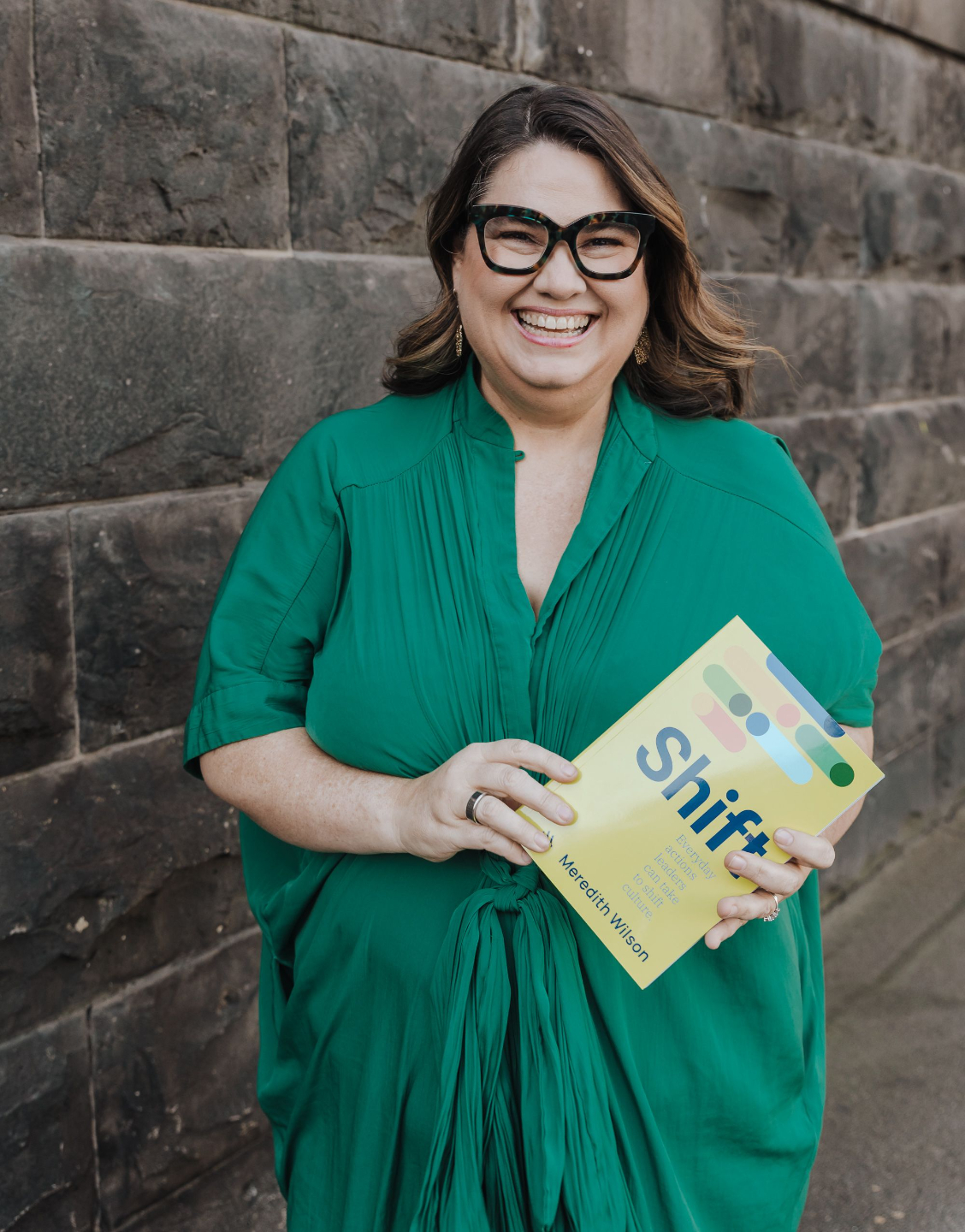
Meredith is the author of Shift: Everyday Actions Leaders Can Take to Shift Culture, a practical guide to making culture simple, tangible and actionable for leaders at every level.
Her depth of experience across people, culture and commercial leadership gives her a distinctive perspective. Grounded in operational reality, sharpened by three decades of practice.
FAQ
What does scaling culture mean?
Scaling culture means sustaining a deliberate culture as an organisation grows, restructures or evolves. It is the discipline of ensuring that the behaviours, values and practices that define your culture replicate across new teams, new leaders and new geographies without losing what made them work. Scaling culture keeps the essential elements intact while allowing the local interpretation that makes culture feel genuine rather than imposed. A finance team and a product team can express the same values differently and still share the ground that matters.
Why do organisations lose their culture as they grow?
Organisations lose culture as they grow because culture in a small organisation is carried by proximity. A founding team can maintain culture through direct contact, personal example and informal relationships. As the organisation grows, those mechanisms stop working. The founding leaders are no longer in every room. New leaders bring different assumptions. New teams develop their own norms. Without deliberate effort to embed culture in systems, rituals, stories and selection practices, the culture dilutes. What made the organisation distinct in its early years becomes a story people tell about what it used to be like.
Where do leaders start when they want to scale culture deliberately?
The most effective starting point is finding where the desired culture already exists and making it visible. Every organisation has pockets of the culture it wants. The teams where the right behaviours are already the norm, the leaders who are already multiplying the right things. The work of scaling culture is to find those pockets, name what is working, connect the people living it and create the conditions for it to spread. Starting with what is already working is more effective than trying to impose culture from the top.
How do you know when scaling culture is actually working?
Culture is scaling well when subcultures feel distinct and recognisably connected. People in different teams or geographies share the same core values and express them differently, and that variation reads as health rather than drift. A practical signal is when leaders who move between teams find the same underlying culture even where the surface behaviours look different.
What’s your next step?
Cultureshift™ Masterclass
How leaders multiply culture. 90 minutes online or two hours in person. A practical experience in reading, shifting and leading culture.
Leading Culture
Shape, shift and scale culture. A 12-month program for leaders responsible for making culture work at scale.
Get the book: Shift
Everyday actions leaders can take to shift culture. Practical, grounded and written for leaders who want to act.
Explore More
Related Explainers
The Culture Stack Explained — How layers of culture accumulate over time
Leadershift Explained — The leadership shift that culture requires
Leaders as Multipliers Explained — Why leadership is the mechanism for culture
Also Published
Culture Creates Capacity — The outcome that scaling culture is designed to produce
Stay connected with Meredith
Subscribe to Culture Creates Capacity, Meredith’s fortnightly reflections on leadership, culture and what’s next. Get insights, practical actions and early access to upcoming events and experiences.
We acknowledge First Nations people both here in Australia and around the world. We have the great privilege of working on lands that have had countless millennia of storytelling, learning, leadership and culture. We pay our deepest respects to the wisdom of Indigenous people and custom past, present and emerging.