The Culture Stack Explained
How organisational culture is built in layers
Meredith Wilson
Organisational culture is many things, accumulated over time. The Culture Stack is a way of seeing the layers of history, habit and meaning that already exist inside your organisation, so you can work with them rather than paint over the top.
What is the Culture Stack?
In software, a tech stack is the collection of tools, platforms and legacy systems that sit on top of each other. Some layers are old and embedded. Some are new and still bedding in. Some are crumbling but still load-bearing. Remove the wrong one and the whole thing breaks.
Culture works the same way. Every organisation has layers. The founding story sits at the base. Early leadership decisions created the next layer. Mergers, restructures, new CEOs, market shifts, crises and growth all deposited their own. Each layer carries assumptions about how things work, what matters and what happens when things go wrong.
The Culture Stack names this reality. It makes visible what most leaders feel but cannot articulate: that their organisation’s culture is an accumulation.
Why the layers matter
Most organisations that set out to shift culture treat it as a single entity. They write a new values statement. They run a launch event. They print posters. And within months, the organisation reverts to something that looks a lot like what was there before.
This happens because the new layer is incompatible with what lies beneath. A values refresh that declares “innovation” will not land in an organisation whose deepest layer rewards compliance and punishes risk. The new layer sits on top. The older, stronger layers push through.
This is why so many culture efforts fail. The leaders are working with several cultures, layered over years and sometimes decades. When leaders can see the layers, they stop trying to paint over the top and start working with what is already there. Some layers need to be preserved. Some need to be refreshed. Some need to be carefully excavated and replaced.
What the Culture Stack looks like in practice
Consider an organisation formed through a merger five years ago. The two legacy cultures still operate underneath the new brand. Finance runs on one set of assumptions about decision-making. Operations runs on another. A new CEO arrives and announces a culture of innovation. The initiative gains traction in pockets where it aligns with one of the legacy cultures. It stalls completely in the other.
The Culture Stack explains why. The CEO is working with at least three cultures: two legacy layers and a new layer that has not yet integrated. The path forward is understanding which legacy layers support the direction and which actively resist it.
This is precision culture work. It is slower than a launch event. It is also more likely to last.
Where the Culture Stack connects
The Culture Stack provides the diagnostic starting point. Once leaders can see the layers, they need tools for working with them. SHAPE names the five conditions people need from their culture. GRASS makes culture visible in everyday organisational life. The Cultureshift™ Formula provides the mechanism for deliberate shift.
The Culture Stack appears in Shift (2023) and is foundational to Meredith Wilson's culture programs and diagnostic work with organisations.
Layer |
What to observe |
What it reveals |
|---|---|---|
| Founding layer | The habits, values and norms from the organisation's earliest years | What the culture treats as given, regardless of what has changed since |
| Growth layers | Culture added during expansions, leadership changes and strategic pivots | Where incompatibilities between old and new values are most visible |
| Disruption layers | Culture shaped by restructures, crises and significant losses | Residual fear, caution or distrust that leaders often cannot explain |
| Emerging layer | The culture currently being formed through current leadership behaviour | Whether the future culture is being shaped deliberately or by default |
Your Culture Stack
Every organisation's culture is layered. The question is which layers are load-bearing.
— Which layer in your culture is the oldest one still shaping behaviour?
— Which is the newest?
— Where are the two in tension, and what does that tension cost?
The answers tell you where to work, and what to work with.
About Meredith Wilson
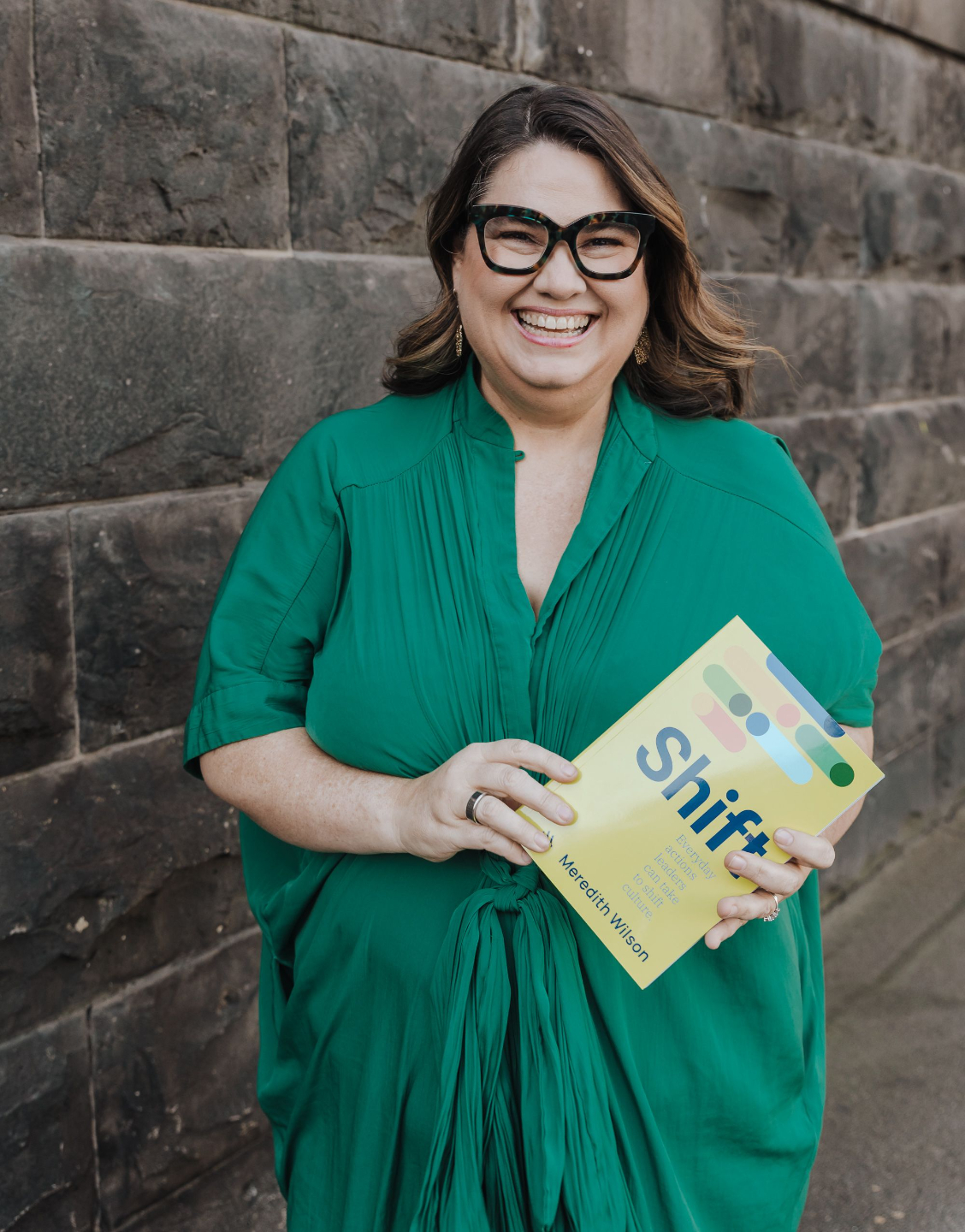
Meredith Wilson makes culture simple and actionable. With over 15 years at the Executive and Board level in ASX10 and global teams, she has led culture through rapid growth, acquisitions, downturns and transformations. Now, as a speaker, author and mentor, Meredith works with senior leaders to shape, shift and lead culture, building the capacity needed for what's next.
Meredith delivers one-on-one mentoring, interactive masterclasses on culture and leadership and curated executive programs and experiences designed for senior leaders.
Meredith is the author of Shift: Everyday Actions Leaders Can Take to Shift Culture, a practical guide to making culture simple, tangible and actionable for leaders at every level.
Her depth of experience across people, culture and commercial leadership gives her a distinctive perspective. Grounded in operational reality, sharpened by three decades of practice.
Frequently Asked Questions
How is organisational culture built?
Culture is built in layers, accumulated over time. The founding story sits at the base, and every leadership change, merger, crisis and growth phase deposits its own layer on top. What a leader experiences as “the culture” is the whole stack at once, each layer still shaping behaviour.
How do I identify the layers in my organisation’s culture?
Start with the founding story and work forward. Every significant leadership change, merger, crisis or growth phase deposited a layer. Ask long-tenured people what has changed and what has stayed the same. The things that persist despite restructures are your deepest layers.
Can you remove a cultural layer?
Layers cannot be deleted the way you uninstall software. They can be weakened over time by consistently reinforcing different behaviours. The strongest tool is leadership consistency: when what leaders model and what they tolerate both align with the direction, old layers lose their reinforcement and gradually lose influence.
What is the difference between the Culture Stack and a culture audit?
A culture audit typically measures the current state. The Culture Stack adds a time dimension. It asks not just “what is the culture now?” but “how did it get here, and which historical layers are still active?” This changes the diagnosis and the intervention.
How does the Culture Stack relate to values work?
Values work is often a new layer added to the stack. The Culture Stack helps leaders understand why that layer may or may not last, depending on what it sits on top of. The most effective values work acknowledges the existing layers and either builds on them or deliberately addresses the tension.
What is the difference between the Culture Stack and Schein’s model of culture?
Edgar Schein’s model describes culture by depth: artefacts, espoused values and underlying assumptions. The Culture Stack adds a second dimension, maturity. It asks not only how deep a cultural element runs but how long it has been present and how embedded it has become. Read together, depth and duration give leaders a sharper diagnostic than either on its own.
How do you map your Culture Stack?
Start by naming the layers already present, from the deep-rooted culture inherited from the organisation’s earliest years through to the culture still forming today. For each layer, look at how embedded it is, how consistently it is reinforced and whether it still serves the direction the organisation is heading. Mapping makes visible which layers are stable, which are fragile and which are aspirational.
Why do organisations have more than one culture?
Culture accumulates. Each phase of an organisation’s life adds a layer, and those layers persist long after the phase that created them has passed. At any moment a leader is working with several cultures at once, each at a different stage of maturity and each pulling with its own assumptions. The Culture Stack makes that reality visible rather than treating culture as a single thing to be fixed.
What's your next step?
Cultureshift™ Masterclass
How leaders multiply culture. 90 minutes online or two hours in person. A practical experience in reading, shifting and leading culture.
Leading Culture
Shape, shift and scale culture. A 12-month program for leaders responsible for making culture work at scale.
Get the book: Shift
Everyday actions leaders can take to shift culture. Practical, grounded and written for leaders who want to act.
Explore More
Related Explainers
SHAPE Explained — The five conditions that make culture work
GRASS Explained — How culture shows up in everyday organisational life
The Cultureshift™ Formula Explained — A formula for deliberate culture shift
Also Published
The Culture Stack — What pancakes can teach us about building cultures that work
Shifts, Drifts, and Daily Culture — The power of microdosing culture
The Culture Leaders See, and the Culture Teams Experience — The more clearly we see our culture, the more deliberately we can shape it
Culture is the Engine of Your Strategy — Why the most underinvested element of organisational performance determines whether the other two work
Stay connected with Meredith
Subscribe to Culture creates Capacity, Meredith’s fortnightly reflections on leadership, culture and what’s next. Get insights, practical actions and early access to upcoming events and experiences.
We acknowledge First Nations people both here in Australia and around the world. We have the great privilege of working on lands that have had countless millennia of storytelling, learning, leadership and culture. We pay our deepest respects to the wisdom of Indigenous people and custom past, present and emerging.